Topic · The Technologies of the Awakened Mind
How to stop overthinking
Overthinking feels like problem-solving, but it rarely solves anything. It runs a simulation that never lands, quietly draining the energy you need to actually live.
Why "just let it go" never works
The advice everyone gives ("stop thinking about it") assumes thinking is a tap you can turn off. It isn't. Attention doesn't respond to a command to be empty; it responds to being given somewhere else to go. That's why willpower fails against rumination and often makes it louder: fighting a thought is one more way of holding it.
The contemplative tradition understood this centuries before anyone measured a brain. Instead of ordering the mind to stop, it hands attention a different task: small, concrete, and incompatible with the loop. The thought doesn't get argued away. It gets displaced.
A protocol, not a mood
What the tradition offers isn't a vibe or a poster. It's a sequence: notice the loop has started, name what kind of loop it is, and move attention to a fixed anchor until the charge drops. Repeated, it retrains where attention goes by default, so the 2 a.m. committee meets less often, and adjourns faster when it does.
A practice for the 2 a.m. loop
Two to five minutes, in bed or anywhere the loop starts.
- Name the loop. Say silently: "this is rehearsal, not information." You're labeling the activity, not judging yourself for it.
- Give attention a job. Count the exhale, or name five sounds in the room. The loop needs your attention to run; occupy it elsewhere.
- Let the thought return and re-anchor. It will come back. That's normal, not failure. Return to the anchor without irritation, as many times as it takes.
- Set one real next step for the morning. If the thought points at something actionable, write the single next step down. Then the mind can release it, because it's held somewhere else.
Go deeper
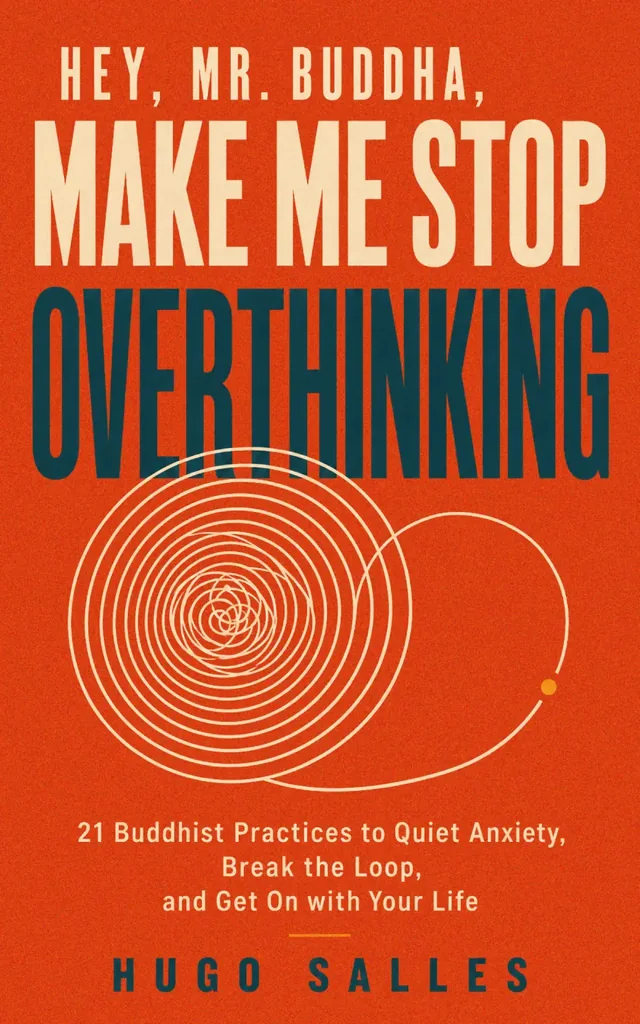
Hey Mr. Buddha, Make Me Stop Overthinking
21 Buddhist practices to quiet the loop, the worry and the decision you keep postponing.